Master Of Philosophy
About M.Phil Course
Merriam Webster defines Philosophy as ‘a discipline comprising its core logic, aesthetics, ethics, metaphysics, and epistemology.’ M.Phil course duration is 2 years and is an ideal course for candidates who want to pursue careers as Lecturer, Teacher, Research Assistant, Assistant Professor, Scientist, Editor, etc. M.Phil full form is Master of Philosophy. Therefore, the structure of the curriculum is orchestrated in a manner to comprehensively provide students with the best theoretical, practical outlook inculcated with research findings.
M.Phil over 4 semesters focuses on various core and elective subjects. Some of the core subjects are Philosophical Foundations of the Subject, Study of Relevant Discipline to the subject of study, Analysis and Domain Study, Review of Origin and Development of the Subject, etc.
M.Phil is a two-year postgraduate academic research degree that deals with aspects of human life and beliefs with inputs from technology and research. An aspirant can pursue an MPhil degree in various specializations such as biotechnology, commerce, botany, English, mathematics, history, Tamil, sociology, computer science, economics, etc. After completing the M.Phil course, students will have various job opportunities such as Teacher, Speaker, Social Service Worker, Editor, Research Assistant, Consultant, Assistant Professor, Scientist, etc. According to Payscale, the average M.Phil salary in India is INR 4.92 LPA.
M.Phil Course Details
| Degree | Masters |
| Full Form | Master of Philosophy |
| Duration | Course Duration of Master of Philosophy [M.Phil] is 2 Years. |
| Age | No age limit |
| Minimum Percentage | 55% |
| Subjects Required | Completed M.Com / MIB / MHROD / MFC / MBA / M.Sc / MA or equivalent |
| Average Fees Incurred | INR 2,000 to 1 LPA |
| Average Salary Offered | INR 4.92 LPA [Source: PayScale] |
| Employment Roles | Assistant Professor, Postsecondary / Higher Education, Research Scientist, Quality Control Analyst, Project Manager - Software Development, Psychologist, High School Teacher etc. |
| Placement Opportunities | Sigma Aldrich Corp, Scientific Publishing Services, High Schools, Colleges and various other Institutions. |
Types of Master of Philosophy
Master of Philosophy is a postgraduate level academic programme. The students are taught about the research aspects of the subjects. The major subjects of the course are history, research methodology, literature, problem-solving, contemporary issues, population movements, culture, and management. The students acquire vast knowledge through studying the following subjects. It further makes it easier for them to work in research firms, academic institutions, and other related work places. They serve the society with their vast knowledge in the specialized subject.
Master of Philosophy Courses
Masters of philosophy is offered in different modes of education. Candidates who are not willing to opt for a full time programme can opt for masters level course from distance learning. The duration of masters of philosophy through distance learning is extended to three more years as compared to the short duration of full time masters of philosophy programme. The fees also vary for both the regular and distance learning M.Phil.
Full-time M.phil: A master of philosophy through the regular program is an ideal pre-doctoral course. It is a regular academic program with a completion duration of one to two years. The students are required to apply the portion of research methodologies they learn in the class and conduct a thesis under supervision.
M.Phil Distance Education: A master of philosophy through distance learning is a flexible program. The duration of the course M.Phil through distance learning can extend up to five years. After the completion of the degree of masters of philosophy, the students can opt for a Ph.D. or post-doctoral academic program. One can also continue the research as per their area of specialization.
Master of Philosophy Specializations
There are specializations in philosophy. Some of the popular specializations are mentioned below:
English: The students are taught research methodologies. They are exposed to literary theory and criticism. They read and learn the literature of past centuries i.e. 18th and 19th century. They learn popular culture and texts. The students are made to participate in drama. They are made to read culture and crime fiction.
Sociology: The students learn the various aspects of society and its development. They get the learning exposure of reflections on ethnography. They understand contemporary class analysis. They gain theoretical knowledge on global issues such as democracy, equality, and social justice. They learn about nature, society, and the environment from a wide perspective. They learn the sociological aspects of civil war.
Political Science: The students get the learning exposure of various research aspects such as the idea of research, quantitative methods, and ethnographic research. The students learn hermeneutics and phenomenology. They are asked to involve in alternative readings of the philosophy of science.
History: The students are asked to research the language of their interest such as Persian, Urdu, English or any other language. They learn about the trends of historiography. They learn the various aspects of research methodology. The course is more focused on early Indian history, medieval Indian history, and modern Indian history.
Business Management: The students are involved in the study of organizational behaviour. They learn management principles. They learn all the important aspects of business management such as human resource management and problem-solving approaches. The study also involves a review of the literature.
Economics: The students are expected to learn research methodology in economics. They learn quantitative techniques, the methodology of dissertation writing, and logic and methodology of science. The students are involved in reading contemporary economic issues. They get exposure to current issues in the World Economy and Indian Economy.
Master of Philosophy Syllabus
Here, in this table below, we will be discussing the Master of Philosophy Syllabus.
| Higher education and faculty development | Changing world and education for the digital world |
| Redefining higher education | Contextualization of multicultural education in India |
| Social context of education | Quality in higher education: national level |
| Economics and education | Quality in higher education: International level |
| Politics and higher education | Paradigms in Educational research |
| Research proposal | One written assignment per course |
| Ethnography | One seminar or book review |
| Academic Writing | Narrative research |
Scope of M.Phil in India and Abroad
The candidates awarded with an M.Phil degree sees an enormous scope in the field. Each sector whether it is Government, Private or Corporate employs M.Phil degree holders in various roles. The recruiters see great potential in postgraduate M.Phil degree holders.
Scope in the Government Sector: The M.Phil degree holders serve in academic institutions run by the Government. They are offered the role of Assistant Professor in colleges. They serve as high school teachers. The research companies also hire M.Phil degree holders. They are offered the roles of research assistants, quality control analysts, and scientists.
Scope in Private Sector: The candidates holding an M.Phil or masters of philosophy degree serve in private sectors as well. They are employed in numerous publishing houses. They work on an editorial role such as editor or writer. They serve as a consultant in many organizations as per their specialization in the subject. They are also offered with academic roles i.e assistant professors and high school teachers in private institutes.
Ph.D.: The candidates can consider a Ph.D. after completion of M.Phil. A Ph.D. after M.Phil has a great scope. The Ph.D. degree holders can work nationally and internationally. The Ph.D. degree holders are offered senior academic roles. They teach in colleges and universities as professors. The candidates can work in senior roles in research firms with a Ph.D. degree.
Careers Opportunities after Master of Philosophy
A masters of philosophy in a respective specialization opens up an ocean of enormous career opportunities with high baggage of salary. A masters of philosophy is a knowledge enhancing programme in the specialized subjects. The individuals acquire vast knowledge with respect to history, research, literature overview and other related aspects.This knowledge builds a ground to opt for an academic profession, research, social service, public speaker, scientist and other professions.
Lecturer: The M.Phil degree holders work as a lecturer in colleges and universities.
Teacher: The candidates with an M.Phil degree are also employed as high school teachers.
Assistant Professor: The candidates serve as assistant professors in colleges and universities. They teach the subjects as per their specialization.
Consultant: The candidates holding an M.Phil degree with a specialization in the business management, economy or statistics serve as a consultant in the companies. They advise the management on issues of financial management, reducing unnecessary expenditures, budget planning, and other related areas. Similarly, other M.Phil degree holders provide consulting services as per their specializations.
Scientist: A scientist works in a research firm. An M.Phil degree holder candidate is offered a senior role and responsible for supervision.
Social Worker: M.Phil degree holders with a specialization in sociology, social work, or human development serve the role of social workers. Either they are self-employed or employed by non-government organizations or NGOs.
Research Associate: A research associate is employed in research firms. A research associate works under the supervision of their seniors or scientists.
Quality Controller: Quality Controller is responsible for quality assurance of the manufactured product. A quality controller is employed by the research organizations, healthcare and pharmaceutical industry, food manufacturing industry and related industries.
Editor: An editor works in a publishing house in an office setting. He or she is responsible for the published content.
Course Comparison
The students must compare different alternatice courses befoew choosing any stream. Thus, some of the courses have been comapred with M Phil.
MPhil vs PhD
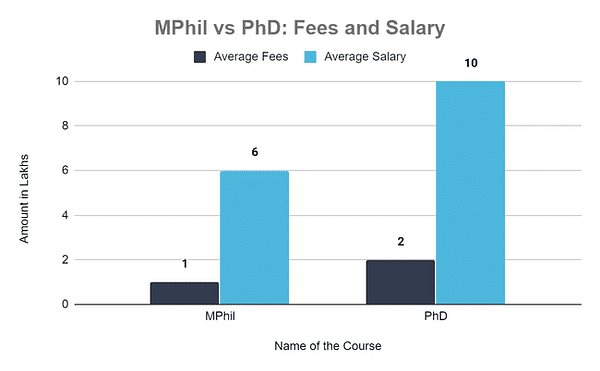
A lot of students get confused if they should opt directly for a PhD degree or pursue an MPhil course first. Both are research-based degrees, PhD will lead you to Doctorate qualification and MPhil will lead you to a PG qualification. Following are the major differences between them:
| Parameters | MPhil | PhD |
|---|---|---|
| Main aim of Study | To allow a student to master a particular subject and provide more relevant information for further research. | To offer an opportunity to the student to add something new to the already existing knowledge |
| Full Form | Master of Philosophy | Doctor of Philosophy |
| Duration | 1.5-2 years | 3-4 years. Sometimes even 5 years |
| Coursework | Balance of theory subjects and experiments | 2-3 theory subjects with a major focus on experiments and research methodology |
| Eligibility | Graduation from any college/university with a minimum of 55% (relaxable for reserved category candidates) marks at UG level. | 55% for General candidates in PG 45% for SC/ST/OBC/specially abled category in PG |
| Admission Process | Merit-based (Based on PG percentage)/ Entrance Test based | Entrance Test based/Merit-based (Based on M.Phil or equivalent percentage) |
| Average Fee | INR 30,000 -1 LPA | INR 50,000-2 LPA |
| Top Colleges | Jawaharlal Nehru University, Banaras Hindu University, University of Hyderabad, Calcutta University, Savitribai Phule Pune University, etc | Indian Institute of Technology Madras- [IITM], Chenna, Indian Institute of Science, Indian Institute of Technology Delhi- [IITD], New Delhi, Indian Institute of Technology Bombay- [IITB], Mumbai, Indian Institute of Technology - [IIT], Kharagpur, etc |
| Average Salary package | INR 5-6 LPA | INR 4-15 LPA |
| Job Profiles | Civil Servant, Assistant Professor, Economist, Author, Journalist, Researcher, etc | University professor, Industrial R&D Lab professionals, Start-Up mentors, Authors,, Senior research scientist, etc |
MPhil vs MSc
Candidates can pursue MSc course in various specializations after completion of their Bachelor degree course. There is often a comparison between MPhil vs MSc regarding which course would bring better prospects to the candidates. We have systematically analyzed the courses based on different parameters so that the candidates are able to make an informed decision on MPhil vs MSc. Which is better?
| Parameters | MPhil | MSc |
|---|---|---|
| Full Form | Master of Philosophy | Master of Science |
| Main aim of Study | To allow the candidates to master the subject before opting for a PhD Course. | To allow the candidates gain specific knowledge in different science subjects. |
| Duration | 1.5-2 years | 2 years |
| Coursework | Balance of theory subjects and research and dissertation | Mainly Theory work and relevant practicals |
| Eligibility | Post Graduation from any college/university with a minimum of 55% (5% relaxable for reserved category candidates). | Graduation with at least 50-60% marks from a recognized university. (5% relaxation for reserved categories) |
| Admission Process | Merit-based (Based on PG percentage)/ Entrance Test based | Merit-based (Based on PG percentage)/ Entrance Test based |
| Average Fee | INR 30,000 -1,00,000 | INR 6,000 - 1,10,000 |
| Top Colleges | Jawaharlal Nehru University, Banaras Hindu University, University of Hyderabad, Calcutta University, Savitribai Phule Pune University, etc | Jawaharlal Nehru University, Banaras Hindu University, Jadavpur University, University of Hyderabad, Jain University, etc |
| Average Salary package | INR 5-6 LPA | INR 5 to 12 LPA |
| Job Profiles | Civil Servant, Assistant Professor, Economist, Author, Journalist, Researcher, etc | Project Assistant, Lab Manager, Pharma Associate, Regulatory Affairs Specialist, Patent Associate, Food Safety Analyst, etc. |
MPhil Colleges in India
Tabulated below are some of the top colleges offering MPhil in India, as per NIRF.
| NIRF Ranking | College/University Name | Admission Process | Average Annual Fees (INR) |
|---|---|---|---|
| 2 | Jawaharlal Nehru University | Entrances-Based | 1,391 |
| 3 | Banaras Hindu University | Entrances-Based | 3,256 |
| 6 | University of Hyderabad | Entrances-Based | 8,670 |
| 7 | Calcutta University | Entrances-Based | 4,400 |
| 9 | Savitribai Phule Pune University | Entrances-Based | 3,500 |
MPhil Colleges in Kolkata
The following are the list of MPhil Colleges in Kolkata
| College Names | Average Fee |
|---|---|
| Rabindra Bharati University | INR 28,500 |
| University of Calcutta | INR 3,400 |
| Centre for Studies in Social Sciences | - |
| Jadavpur University | INR 3,600 |
MPhil Colleges in Delhi
The following are the list of MPhil Colleges in Delhi
| College Names | Average Fee |
|---|---|
| Jawaharlal Nehru University - [Jnu], New Delhi | INR 1391 |
| National Institute Of Educational Planning And Administration - [Niepa], New Delhi | INR 18,500 |
| Jamia Millia Islamia | INR 1100 |
| Jamia Hamdard University | INR 25,000 |
| Department of Education, University of Delhi | - |
MPhil Colleges in Mumbai
The following are the list of MPhil Colleges in Mumbai
| College Names | Average Fee |
|---|---|
| Mumbai University - [Mu], Mumbai | INR 13,180 |
| Tata Institute of Social Sciences, Mumbai | INR 175,000-INR 206,000 |
| Amity University, Mumbai | INR 387,000 |
| D.T.S.S. College Of Commerce Malad, Mumbai | INR 35,000 |
| Nirmala Niketan College of Home Science | - |
MPhil Colleges in Hyderabad
The following are the list of MPhil Colleges in Hyderabad
| College Names | Average Fee |
|---|---|
| University of Hyderabad | INR 1600 |
| Potti Sreeramulu Telugu University | INR 3400 |
| IIIT Hyderabad | - |
| Directorate Of Sorghum Research - [DSR], Hyderabad | - |
| Dr. B.R. Ambedkar Open University - [BRAOU], Hyderabad | INR 18,500 |
MPhil Colleges in Pune
The following are the list of MPhil Colleges in Pune
| College Names | Average Fee |
|---|---|
| Brihan Maharashtra College of Commerce , Pune | - |
| Savitribai Phule Pune University | INR 3,000 |
| Poona College of Arts, Science and Commerce | - |
| Gramonnati Mandal's Arts,Commerce and Science College | INR 30,600 |
| Interdisciplinary School Of Scientific Computing - [ISSC], Pune | INR 5,960 |
| Yashwantrao Chavan Institute Of Social Science Studies And Research - [YCISSSR], Pune | INR 15,000 |
MPhil Colleges in Bangalore
The following are the list of MPhil Colleges in Bangalore
| College Names | Average Fee |
|---|---|
| Christ University | INR 30,000 |
| Jain University, Bangalore | - |
| School of Law, Christ University | INR 60,000 |
| National Institute of Mental Health and Neurosciences | INR 29,700 |
| M.S. Ramaiah University Of Applied Sciences - [MSRUAS], Bangalore | INR 121,000 |
| South Asia Institute Of Advanced Christian Studies - [SAIACS], Bangalore | INR 36,000 |
| National Bureau Of Agricultural Insect Resources - [NBAIR], Bangalore | - |
MPhil Colleges in Coimbatore
The following are the list of MPhil Colleges in Coimbatore
| College Names | Average Fee |
|---|---|
| CBM College Of Arts And Science, Coimbatore | - |
| Sri Ramakrishna Mission Vidyalaya College Of Education - [SRKMVCOE], Coimbatore | - |
| RVS Institute Of Management Studies And Research - [RVSIMSR, Coimbatore | INR 14,100 |
| K.S.G. College Of Arts And Science, Coimbatore | - |
| Salim Ali Centre For Ornithology And Natural History - [SACON], Coimbatore | INR 8,500 |
| School Of Commerce, Bharathiar University, Coimbatore | INR 9,300 |
| Hindusthan College of Arts and Science - HICAS Coimbatore | INR 82,800 |
| Coimbatore Institute of Management and Technology | INR 7900 |
| V.L.B. Janakiammal College of Arts and Science | INR 3500-INR 4500 |
| Nallamuthu Gounder Mahalingam College | - |
| Kovai Kalaimagal College of Arts and Science | INR 14,000 |
MPhil JNU vs MPhil BHU: What is the Difference?
Following table shows a comparison of pursuing MPhil from JNU vs BHU.
| Parameters | MPhil JNU | MPhil BHU |
|---|---|---|
| College Overview | Jawaharlal Nehru University (JNU) is one of India’s top-ranked universities for Post-graduate and research studies. It has received the Best University Award from the President of India in 2017. It offers MSc courses in Biotechnology, Environmental Science, Chemistry, Life Science, Mathematics Physics, etc | Banaras Hindu University (BHU) is a central university situated in Varanasi, Uttar Pradesh. It offers MSc courses in Botany, Zoology, Chemistry, Computer Science, Mathematics, Home Science, etc. |
| Location | New Delhi | Varanasi |
| NIRF Ranking | 2 | 3 |
| Average Total Fees | INR 1,391 | INR 3,256 |
| Average Placement Package | INR 16 LPA | INR 14.75 LPA |
| Top Recruiting Companies | TCS, Hitachi, Barclay, Akash Institute, HSBC, TCS CTO, 3I Infotech, Zoom Tech, Spring Talent, Acxiom, Aganita, Thin CI, etc. | Accenture, Blue Star, Cognizant, NIIT, PCS, HCL-Tech, Infosys, Canbay, TCS, Wipro Technologies, Yahoo, Impetus etc. |
Study MPhil Abroad
The basic requirement for studying MPhil courses in foreign countries is an excellent academic record throughout. The candidates are required to pass their post graduate level exam with a minimum percentage, in the range between 60-80% from a reputed university. Candidates are also required to score 70% in their higher secondary level examinations with at least (65% in maths and English).
The following are the some of the general details:
- The overall cost of pursuing MPhil in Abroad is expensive as the candidates have to pay fees ranging between INR 10 Lac to INR 20 Lac. In some cases the tuition fees can shoot upto INR. On top of that candidates have to factor in the cost of living of the respective countries.
- Candidates can also avail several scholarship programs from different agencies as well as from the universities. Check out : Scholarships program to Study Abroad
- The candidates have to take the english proficiency tests like TOEFL, IELTS, in order to pursue the course.
- In some cases the candidates have to produce a letter of recommendation and proof of related work experience.
UK
Candidates who want to study in UK should keep the following things in mind before applying for the MPhil course
- The Duration of the course can range between 1-3 years.
- The candidates need to pass their post graduate exam with a high second class degree (Over 60%). In some universities the candidates need to have honours degree to pursue the course.
- Candidates need to pass the english proficiency test such as TOEFL (Minimum score of 80) and IELTS (Minimum score of 6.5).
- The candidates in some cases need to produce work experience or evidence of their written works
- The average fees range between INR 15,00,000-INR 20,00,000. In some cases it can shoot upto INR 37,00,000 per annum.
| College/University Names | Average Fees |
|---|---|
| Bournemouth University | INR 15,42,076- INR 17,47,693 |
| University of Cambridge | INR 28,28,240- INR 37,01,504 |
| University of London | INR 11,30,663-INR 16,44,601 |
| University of Manchester | INR 20,04,421 |
| University of Greenwich | INR 15,93,374 |
| Oxford University | INR 25,13,557 |
| University of Hull | INR 15,41,665-INR 17,47,221 |
Australia
Candidates who want to study in Australia should keep the following things in mind before applying for the MPhil course
- Candidates are required to score at least upper second class in the bachelor degree from a recognized university . Candidates need to produce another degree with a significant research component or thesis is required for admission to some colleges.
- The candidates also need to produce a significant research publication and related work experience relevant to the field of study.
- The candidates need to pass the english proficiency tests such as IELTS or TOEFL.
- The average duration of the course is 2 years
- The average fees ranges between INR 17,00,000-INR 24,00,000
| College/University Names | Average Fees |
|---|---|
| Australian National University | INR 220,573 (Per Unit Course) |
| James Cook University | INR 21,74,936- INR 22,48,741 |
| Bond University | INR 2,219,596 |
| Griffith University | INR 17,86,340 |
| Murdoch University | - |
| University of Sydney | INR 2,317,241 |
| University of Melbourne | INR 2,397,406 |
New Zealand
Candidates who want to study in New Zealand should keep the following things in mind before applying for the MPhil course
- The candidates need to score at least B or equivalent grade from a recognised university in relevant stream.
- The stream includes 4 years bachelor degree, bachelor degree with honours, bachelor degree and postgraduate diploma or Bachelor degree with 3 years relevant work experience.
- The duration of the course is 1 to 2 years.
- The candidates need to pass their english proficiency tests IELTS (minimum score of 6) or TOEFL (Minimum score of 80).
- The average course fee ranges between INR 800,000-INR 20,00,000
| College Names | Average Fees |
|---|---|
| AUT University | INR 20,28,037 |
| Lincoln University | - |
| Massey University | INR 814,666 |
| Victoria University of Wellington | INR 23,71,622 |
| University of Waikato | INR 15,06,647.-INR 19,81,365 |
MPhil Jobs and Salary
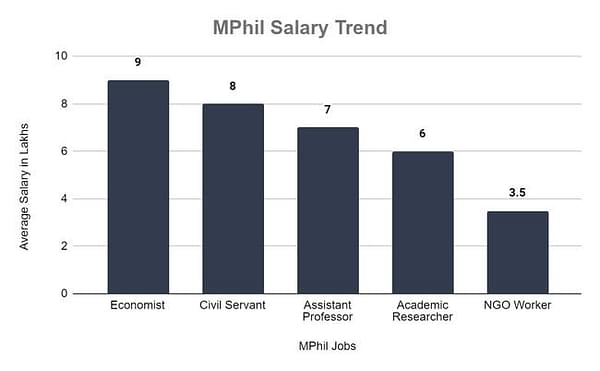
Candidates after completion of the MPhil courses get job opportunities in various sectors such as civil services, archeology, economics, etc from their field of studies. Most MPhil graduates opt for research or teaching jobs after the completion of MPhil courses.
Following table shows some of the major job profiles after doing MPhil in India:
| Job Profile | Job Description | Average Salary (INR) |
|---|---|---|
| Civil Servant | Working in civil services involves the implementation, formulation, and execution of the government’s policy in the public domain. | 8 LPA |
| Economist | An Economist is involved in the interpretation of market dynamics in terms of economic principles. | 9 LPA |
| NGO Worker | An NGO worker can indulge in various areas of public policy implementation in order to enhance the accessibility of the government’s scheme. | 3.5 LPA |
| Academic Researcher | Work of researchers involves a variety of functions like public policy analysis, research in academics, pattern analysis, data analysis. | 6 LPA |
| Assistant Professor | This would involve a regular teaching job of teaching the subject to college-level students. There are plenty of options in the private sector as well as the government sector. | 7 LPA |
MPhil Skill Sets
Candidates who have passed their MPhil Courses should possess the following skill sets that would allow them to work efficiently in their relevant field. The following are the Master of Philosophy Skill-sets
| Good Analytical Skills | Good writing Capacity | Project Management skills | Reasoning Skills | Critical Thinking |
| Collaboration | Leadership | Keen Observer | Self-Motivated | Good at research |

M.Phil Scope
We have already talked about major job profiles in the above section. Here, we will discuss the future scope after MPhil course completion.
PhD: Doctor of Philosophy or PhD is a research degree of 3-5 years in which students produce their own thesis and defend it in front of elite and reputed people of that industry. A lot of MPhil students like to go for PhD studies to go forward in their research career as it was the bridge between masters and the PhD course.
Here are some of the highlights of the PhD course.
| Full Form | Doctor of Philosophy (PhD) |
| Duration | 3-5 years |
| Eligibility | Minimum of 55% marks in the PG Level (Relaxation of 5% for the candidates of reserved categories) |
| Entrance Exam | UGC NET, RUET, CUCET, and many more |
| Top Colleges /Universities | IIT Madras, Chennai, Mumbai University, University of Calcutta, etc |
| Average Fee | INR 50,000-2 LPA |
| Average Salary | INR 4-15 LPA |
| PhD Jobs | University professor, Industrial R&D Lab professionals, Start-Up mentors, Authors, Senior research scientist and others |
Commonly pursued PhD courses are:
| PhD in Finance | PhD in Psychology | PhD in Law |
| PhD in Commerce | PhD in Computer Science | PhD in Physics |
| PhD in Management | PhD in Maths | PhD in Biotechnology |
| PhD in English | PhD In Economics | PhD in History |
MPhil is a research-based degree, and students who are interested in sticking to the field of research and academic teachings can go ahead for higher studies in any of the above subjects. This will not only enhance their subject knowledge but also will bring them advanced academic opportunities.
How to Get Admission For M.Phil?
To be eligible for MPhil admission, students must ensure they satisfy the basic eligibility criteria. The selection process for MPhil courses can be based on two ways. While some colleges offer MPhil admission based on merit, others conduct an entrance exam for the same. In certain government colleges, there may be a quota for the selection of candidates for admission into the M.Phil course. Application for the M.Phil admission process may be availed from the college portal or by directly visiting the college admissions office. The details of the Mphil admission 2021 process are listed below:
How To Apply For M.Phil?
MPhil course details can be availed by the candidate by visiting the college website through which the aspirant can begin their application process. Along with applying through the online mode, the aspirants of 2 years M.Phil courses duration can also apply offline by visiting the admissions office of the respective institution. Students applying for the M.Phil course, either offline or online mode are required to provide all the valid documents to verify themselves for the admissions process. After the submission of the application, students will receive further correspondence from the college.
Selection Criteria
The selection criteria for MPhil admissions 2021 in some colleges are conducting a personal interview round for candidates having the basic eligibility criteria. Various other colleges conduct the M.Phil entrance exam in addition to the basic eligibility criteria to ensure they selected the best suitable candidate with the comprehensive knowledge and skill set. For the entrance-based selection process, admissions are strictly offered to candidates who pass a particular M.Phil entrance exam such as MPhil Entrance Test, JNUEE, CUCET, BHU RET, UGC NET, GATE, etc. The admit card and other relevant details are published on the college website beforehand. Students can view their admission results on the college portal or receive them via email.
Eligibility Criteria For M.Phil
The MPhil Eligibility Criteria for MPhil Admission varies from one university to another, however The basic criteria or requirement remains the same for the majority of the universities.
- The most basic MPhil eligibility criteria is that the candidates should pass their post graduate course from a recognized university with a minimum aggregate score of 55%.
- A 5 % relaxation is provided to the candidates belonging to the reserved categories.
- He/She shall not be having any backlog or compartment in any of the subject(s) at PG level that is yet to be cleared at the time of taking admissions.
- Apart from the above-mentioned eligibility criteria, various colleges and institutes may have their own additional criteria which the students would have to satisfy in order to take admission.
- In case of reserved category students, they would have to present their reservation certificates issued by the competent authorities in order to avail the benefits applicable to them
- Entry to the MPhil courses requires the candidates to appear for the admission test that are administered at national level or institute level. The entrance exam includes GATE, MPhil Entrance Test, UGC JRF, JNUEE , etc.
Apart from these some of the stand-out eligibility criteria of some of the colleges are
- In the case of application to the University of Calcutta, the candidates have to provide a domicile certificate stating that they have been residing in the state for more than 10 years. Also candidates have to carry their original certificates at the time of submission of the application form.
- Admission to the Banaras Hindu University is done through the BHU Research Entrance Test (RET). The admission criteria change slightly every year with the Academic Council of the University deciding the norm .
- Delhi University allows relaxation of 5% for the candidates who have completed their masters before September 19, 1991
Popular Entrance Exams for M.Phil
For admissions into M.Phil in India, the basic M.Phil eligibility for most colleges is merit-based selection followed by a personal interview. However, most colleges conduct an entrance-based selection process to find the best suitable candidate for the M.Phil course. Students must prepare for the M.Phil entrance exam along all the lines of requirements. Aspirants should study closely the question paper pattern from previous years and prepare adequately. M.Phil entrance exam for various colleges in India is listed below:
- GATE
- UGC NET
- CUCET
- JNUEE
- OUCET
- M.Phil Entrance Test
- BHU RET
A Quick Glance at the M.Phil Entrance Exams
MPhil full form is Master of Philosophy, which at the sound of it can be sometimes confusing for students to understand what the course offers. Questions such as ‘What is MPhil’ are common statements coming from aspirants that help them in understanding the course. Students should start preparing adequately by analyzing the M.Phil details such as previous years’ papers and their patterns. This ensures timely preparation for the entrance exams. Listed below is the standard pattern for the M.Phil entrance exam:
- The duration of the exam is 3 hours
- The exam will be conducted in the offline mode
- The maximum mark of the question paper is 75
- There will be 3 sections of 25 marks each
- The final admission will only be considered after the personal interview
- The personal interview carries 25 marks
Preparation Tips For M.Phil
Aspirants of the M.Phil course should prepare for the M.Phil entrance exam along all the lines of requirements. This requires going through a detailed process of analyzing the question papers from the previous years and trying to understand ‘What is M.Phil’ and its requirements. Listed below are some of the preparation tips for the M.Phil entrance exam:
- Time Management: M.Phil requires a deep understanding of concepts by the individual. A well-timed preparation can only ensure that the students provide a sound performance.
- Regular Practice: Students should complete all the syllabus portions required for M.Phil eligibility. This can be achieved only with regular practice during the full course of the preparation process.
Why study Master of Philosophy?
- A precursor to the PhD Course: The MPhil Course has long been seen as a gap between the master's degree and the PhD program.The course helps the candidates to undergo a holistic approach in training the mind of the students about the nuances of research, building up research skills and knowledge that would help in pursuing full scale PhD program.
- Good Pay and Other Perks: The MPhil program promises good returns to the candidates. An MPhil course generally costs the candidates a fee of around INR 1100-INR 200,000 (The numbers are considerably higher for the private colleges). The website PayScale reports that a M.Phil candidate earns an average of INR 508,600 per annum. Thus, the candidates are able to recoup their investment in studies quickly. The MPhil candidates are entitled to other perks like medical insurance, dental check up, etc.
- Job Security: The candidates who have completed their MPhil courses are generally absorbed into teaching professions or research facilities. A teacher's job role is one of the most secure jobs in India. In 2018, the Honourable Supreme Court of India pitched for the job security of all teachers across the educational level in India. Even during the covid 19 pandemic the teaching sector according to a report by Naukri reported the second-highest hiring after healthcare in December 2022.
- Specialization: The MPhil course offers a large number of specialization programs so that the candidates are able to choose between the different fields of study according to their interests. There are more than 30 specializations available in India. The MPhil in Psychology specialization course is gaining popularity in India due to the rise in mental health problems in India, with more than 150 million Indians needing therapy.
- Entrepreneurship Opportunities: As explained in the above segments, most of people after completing their MPhil course go for the teaching profession. Many MPhil holders start coaching centres after completion of the degree. The Times of India reports that there are 7.1 crore students who opt for tuitions at various levels thus creating entrepreneurship opportunities.
How to Get Admission For M.Phil?
To be eligible for MPhil admission, students must ensure they satisfy the basic eligibility criteria. The selection process for MPhil courses can be based on two ways. While some colleges offer MPhil admission based on merit, others conduct an entrance exam for the same. In certain government colleges, there may be a quota for the selection of candidates for admission into the M.Phil course. Application for the M.Phil admission process may be availed from the college portal or by directly visiting the college admissions office. The details of the Mphil admission 2021 process are listed below:
How To Apply For M.Phil?
MPhil course details can be availed by the candidate by visiting the college website through which the aspirant can begin their application process. Along with applying through the online mode, the aspirants of 2 years M.Phil courses duration can also apply offline by visiting the admissions office of the respective institution. Students applying for the M.Phil course, either offline or online mode are required to provide all the valid documents to verify themselves for the admissions process. After the submission of the application, students will receive further correspondence from the college.
Selection Criteria
The selection criteria for MPhil admissions 2021 in some colleges are conducting a personal interview round for candidates having the basic eligibility criteria. Various other colleges conduct the M.Phil entrance exam in addition to the basic eligibility criteria to ensure they selected the best suitable candidate with the comprehensive knowledge and skill set. For the entrance-based selection process, admissions are strictly offered to candidates who pass a particular M.Phil entrance exam such as MPhil Entrance Test, JNUEE, CUCET, BHU RET, UGC NET, GATE, etc. The admit card and other relevant details are published on the college website beforehand. Students can view their admission results on the college portal or receive them via email.
How to Get Admission For M.Phil?
To be eligible for MPhil admission, students must ensure they satisfy the basic eligibility criteria. The selection process for MPhil courses can be based on two ways. While some colleges offer MPhil admission based on merit, others conduct an entrance exam for the same. In certain government colleges, there may be a quota for the selection of candidates for admission into the M.Phil course. Application for the M.Phil admission process may be availed from the college portal or by directly visiting the college admissions office. The details of the Mphil admission 2021 process are listed below:
How To Apply For M.Phil?
MPhil course details can be availed by the candidate by visiting the college website through which the aspirant can begin their application process. Along with applying through the online mode, the aspirants of 2 years M.Phil courses duration can also apply offline by visiting the admissions office of the respective institution. Students applying for the M.Phil course, either offline or online mode are required to provide all the valid documents to verify themselves for the admissions process. After the submission of the application, students will receive further correspondence from the college.
Selection Criteria
The selection criteria for MPhil admissions 2021 in some colleges are conducting a personal interview round for candidates having the basic eligibility criteria. Various other colleges conduct the M.Phil entrance exam in addition to the basic eligibility criteria to ensure they selected the best suitable candidate with the comprehensive knowledge and skill set. For the entrance-based selection process, admissions are strictly offered to candidates who pass a particular M.Phil entrance exam such as MPhil Entrance Test, JNUEE, CUCET, BHU RET, UGC NET, GATE, etc. The admit card and other relevant details are published on the college website beforehand. Students can view their admission results on the college portal or receive them via email.
Popular Entrance Exams for M.Phil
For admissions into M.Phil in India, the basic M.Phil eligibility for most colleges is merit-based selection followed by a personal interview. However, most colleges conduct an entrance-based selection process to find the best suitable candidate for the M.Phil course. Students must prepare for the M.Phil entrance exam along all the lines of requirements. Aspirants should study closely the question paper pattern from previous years and prepare adequately. M.Phil entrance exam for various colleges in India is listed below:
- GATE
- UGC NET
- CUCET
- JNUEE
- OUCET
- M.Phil Entrance Test
- BHU RET
A Quick Glance at the M.Phil Entrance Exams
MPhil full form is Master of Philosophy, which at the sound of it can be sometimes confusing for students to understand what the course offers. Questions such as ‘What is MPhil’ are common statements coming from aspirants that help them in understanding the course. Students should start preparing adequately by analyzing the M.Phil details such as previous years’ papers and their patterns. This ensures timely preparation for the entrance exams. Listed below is the standard pattern for the M.Phil entrance exam:
- The duration of the exam is 3 hours
- The exam will be conducted in the offline mode
- The maximum mark of the question paper is 75
- There will be 3 sections of 25 marks each
- The final admission will only be considered after the personal interview
- The personal interview carries 25 marks
Preparation Tips For M.Phil
Aspirants of the M.Phil course should prepare for the M.Phil entrance exam along all the lines of requirements. This requires going through a detailed process of analyzing the question papers from the previous years and trying to understand ‘What is M.Phil’ and its requirements. Listed below are some of the preparation tips for the M.Phil entrance exam:
- Time Management: M.Phil requires a deep understanding of concepts by the individual. A well-timed preparation can only ensure that the students provide a sound performance.
- Regular Practice: Students should complete all the syllabus portions required for M.Phil eligibility. This can be achieved only with regular practice during the full course of the preparation process.
Why study Master of Philosophy?
- A precursor to the PhD Course: The MPhil Course has long been seen as a gap between the master's degree and the PhD program.The course helps the candidates to undergo a holistic approach in training the mind of the students about the nuances of research, building up research skills and knowledge that would help in pursuing full scale PhD program.
- Good Pay and Other Perks: The MPhil program promises good returns to the candidates. An MPhil course generally costs the candidates a fee of around INR 1100-INR 200,000 (The numbers are considerably higher for the private colleges). The website PayScale reports that a M.Phil candidate earns an average of INR 508,600 per annum. Thus, the candidates are able to recoup their investment in studies quickly. The MPhil candidates are entitled to other perks like medical insurance, dental check up, etc.
- Job Security: The candidates who have completed their MPhil courses are generally absorbed into teaching professions or research facilities. A teacher's job role is one of the most secure jobs in India. In 2018, the Honourable Supreme Court of India pitched for the job security of all teachers across the educational level in India. Even during the covid 19 pandemic the teaching sector according to a report by Naukri reported the second-highest hiring after healthcare in December 2022.
- Specialization: The MPhil course offers a large number of specialization programs so that the candidates are able to choose between the different fields of study according to their interests. There are more than 30 specializations available in India. The MPhil in Psychology specialization course is gaining popularity in India due to the rise in mental health problems in India, with more than 150 million Indians needing therapy.
- Entrepreneurship Opportunities: As explained in the above segments, most of people after completing their MPhil course go for the teaching profession. Many MPhil holders start coaching centres after completion of the degree. The Times of India reports that there are 7.1 crore students who opt for tuitions at various levels thus creating entrepreneurship opportunities.